

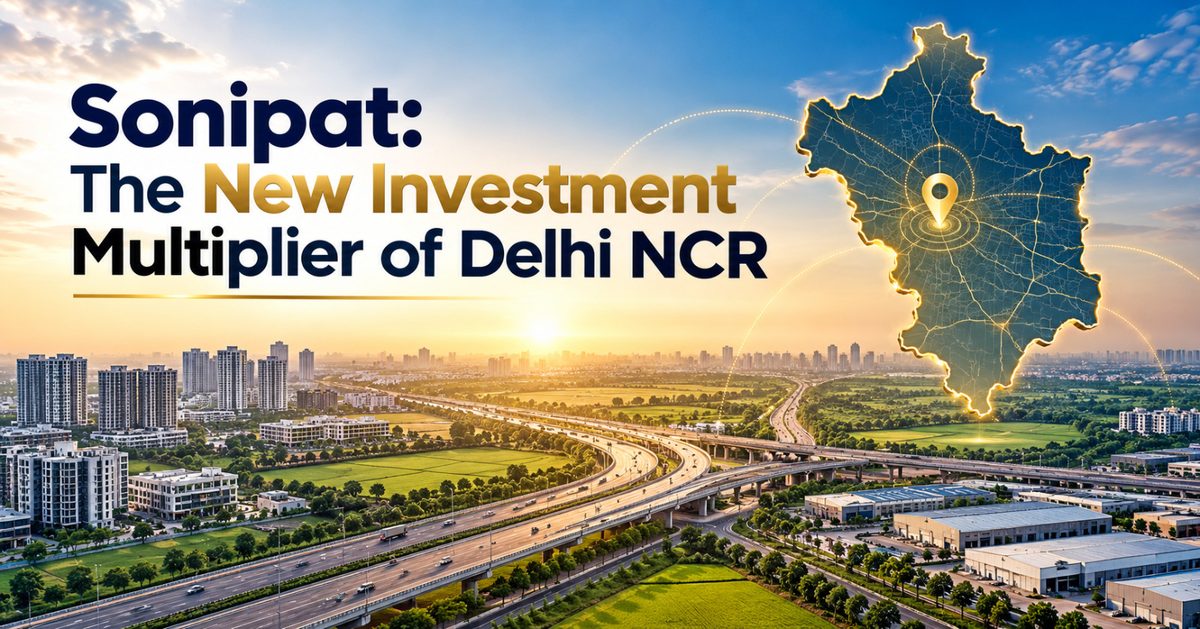
Sonipat: The New Investment Multiplier of Delhi NCR
by Admin | October 06, 2026A New Phase in NCR’s Investment: Delhi NCR has always evolved in phases. For years, investment largely remained concentrated in well-developed urban pockets where infrastructure was already established, and demand was predictable. However, as these markets matured and prices stabilised, investors began looking outward. The next cycle of growth is no longer centred only around established zones, but around emerging corridors where infrastructure and economic activity are expanding together.
Sonipat has gradually entered that conversation. Once viewed mainly as an affordable extension of Delhi, the city is now drawing attention for a different reason: its ability to combine connectivity, industrial growth, and structured development. This combination is what often turns a growing city into an investment multiplier.
Infrastructure Setting the Direction
Infrastructure plays a defining role in shaping investment patterns. Over the past few years, improved highway networks and stronger regional linkages have strengthened Sonipat’s accessibility within the NCR framework. Travel time to Delhi has reduced, logistics routes have become more active, and industrial movement across Haryana has intensified.
Such improvements rarely act in isolation. When connectivity improves, businesses gain operational ease. When businesses expand, employment increases. As employment grows, housing demand rises. Commercial activity follows to support the expanding population. Over time, this interconnected growth creates stability.
In Sonipat’s case, infrastructure has not only improved access, but it has also improved confidence.
Industrial Growth Adding Depth
A key factor distinguishing Sonipat from purely residential expansion zones is its growing industrial presence. Industrial corridors around the region are becoming more active, and logistics networks are strengthening. Manufacturing and warehousing activities bring long-term economic depth to any region.
This industrial base creates sustained demand rather than temporary speculation. Job creation supports residential absorption. Commercial establishments develop around employment hubs. The ecosystem begins to balance itself.
For investors, this balance is critical. Growth supported by industry tends to be steadier and more resilient compared to growth driven only by short-term residential interest.
Entering Before Maturity
Every region moves through development stages. In mature markets, price growth often slows because infrastructure and demand are already reflected in valuations. Emerging corridors, on the other hand, offer a different kind of opportunity for participation during the growth phase.
Sonipat appears to be in this transitional stage. Infrastructure projects are progressing, industrial activity is expanding, and demand is diversifying across segments. Yet the city has not reached full saturation. This positioning allows investors to consider entry before complete maturity.
The idea of a multiplier does not depend on rapid price spikes. It depends on steady compounding driven by multiple reinforcing factors.
Planning as the Long-Term Anchor
While infrastructure and industry create momentum, planning determines sustainability. Cities that expand without organised layouts often struggle later with congestion and mixed land use challenges. Structured development protects long-term value.
In Sonipat, planning-led initiatives such as Right Land reflect a growing emphasis on clarity in zoning and integrated township design. By focusing on organised development rather than fragmented expansion, such initiatives align with the city’s evolving economic role. When growth is guided by planning, the multiplier effect becomes more durable.
A Strategic Node in NCR’s Future
Sonipat is no longer functioning only as a peripheral residential belt. It is gradually strengthening its economic identity within NCR. Improved connectivity, expanding industrial corridors, and increasing investor attention signal a broader transition.
The city’s rise may not be dramatic, but it is grounded in tangible fundamentals. As NCR decentralises and growth spreads across well-connected nodes, cities that combine infrastructure, economic depth, and planning discipline are likely to shape the next investment cycle.
Sonipat’s current trajectory places it firmly within that shift.
The multiplier story here is not about sudden surges. It is about steady structural growth. And in long-term investment, structural growth often proves to be the most powerful foundation.