

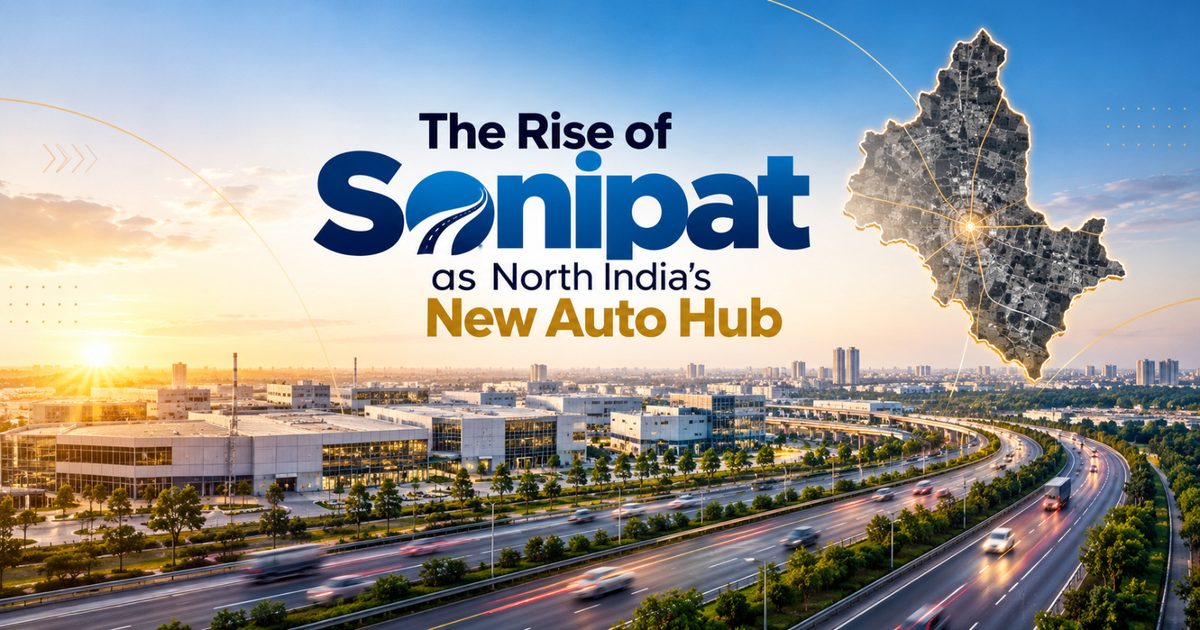
The Rise of Sonipat as North India’s New Auto Hub
by Admin | October 06, 2026For a long time, Sonipat was primarily viewed as a residential extension of Delhi. Today, the city is gradually building a different identity, one increasingly connected to industrial growth and the rise of a structured auto hub within the NCR region.
As manufacturing activity expands beyond crowded urban centres, well-connected satellite cities are gaining importance. Sonipat is emerging as one such location, supported by improving infrastructure, strong highway connectivity, and growing industrial presence.
Why Sonipat Is Attracting Auto Businesses
The development of any successful auto hub depends on practical factors, such as reliable connectivity, supply chain efficiency, and availability of organised industrial space.
Sonipat benefits from direct access to major highways and regional corridors, linking it efficiently to Delhi and key industrial zones across Haryana. For auto businesses, this reduces logistics friction and supports smoother movement of goods.
At the same time, the city offers relatively lower congestion and scalable land compared to central NCR locations, making expansion more feasible for manufacturers, suppliers, and service operators.
A Growing Auto Ecosystem
The activity taking shape in Sonipat is not limited to retail showrooms. It reflects the formation of a broader auto ecosystem, including:
• Component manufacturing
• Assembly and servicing facilities
• Spare parts distribution
• Warehousing and logistics operations
• EV charging and related infrastructure
North India already hosts major players such as Maruti Suzuki, Motherson Group, Minda Industries, JBM Group, and global supply chain companies like Sumitomo Corporation. As these companies expand their networks across the region, strategically connected industrial cities naturally gain importance within the supply chain landscape.
Sonipat’s location allows it to align with this broader industrial movement.
The EV Opportunity
India’s shift toward electric mobility is further strengthening emerging auto hubs. Cities with structured industrial planning and strong road connectivity are better positioned to support EV assembly, charging networks, and battery-related operations.
Sonipat’s evolving infrastructure places it within this opportunity cycle.
A Structural Shift in Growth
The rise of an auto hub typically brings a wider economic impact. Industrial growth generates employment, supports ancillary businesses, and increases both commercial and residential demand.
For investors, this type of development signals long-term economic depth rather than temporary demand.
As infrastructure strengthens and industrial activity continues to expand, Sonipat’s role within NCR is evolving from a peripheral town to a developing industrial node. Planning-led developments in the region, including initiatives like Right Land, reflect this broader transition toward structured and sustainable growth.
And the rise of the auto hub is becoming a defining part of that journey.
The Rise of Sonipat as North India’s New Auto Hub
From Residential Belt to Industrial Momentum: Sonipat has long been associated with residential growth around Delhi. But over the past few years, a different story has been unfolding. The city is steadily strengthening its industrial base, and the emergence of an organised auto hub is becoming a defining part of its evolution.
The shift is not accidental. It reflects a broader movement of manufacturing activity expanding beyond saturated urban centres into well-connected industrial corridors. In this transition, cities with strong road networks and scalable land naturally gain importance.
Sonipat is positioning itself within that landscape.
The Advantage of Location and Connectivity
Every successful auto hub depends on operational efficiency. For manufacturers and suppliers, time and movement matter. Reliable highway access, proximity to key industrial belts, and logistical ease directly impact cost and scalability.
Sonipat benefits from direct connectivity to major highways and regional corridors linking Delhi and Haryana’s industrial network. This reduces transport time for finished vehicles, spare parts, and raw materials.
Unlike congested NCR locations, the city still offers comparatively lower traffic pressure and expansion-friendly industrial space. For companies looking to scale operations without operational bottlenecks, this becomes a practical advantage.
It is this combination of connectivity and available land that is drawing attention.
Building a Complete Auto Ecosystem
An auto hub is not created by showrooms alone. It grows when multiple layers of activity come together.
In Sonipat, the development extends across:
• Auto component manufacturing
• Assembly and servicing facilities
• Spare parts distribution
• Warehousing and logistics networks
• EV charging and mobility infrastructure
North India already hosts established players such as Maruti Suzuki, Motherson Group, Minda Industries, JBM Group, and global supply chain networks including Sumitomo Corporation. As these companies expand operations and vendor networks, satellite industrial locations gain relevance within the broader supply chain ecosystem.
Sonipat’s location allows it to integrate naturally into this industrial movement.
The Electric Mobility Push
The growth of electric vehicles is adding another layer to this transformation. EV manufacturing, battery-related operations, and charging infrastructure require well-planned industrial zones and strong road connectivity.
Cities that offer structured planning and accessible logistics stand to benefit from this shift. Sonipat’s infrastructure trajectory places it within this opportunity.
The move toward electric mobility does not replace the existing auto ecosystem. It strengthens it. And that makes the region more diversified and future-oriented.
Economic Impact and Long-Term Stability
The rise of an auto hub influences more than just manufacturing. It generates employment, strengthens ancillary industries, and increases commercial and residential demand. When industrial activity deepens, economic stability improves. For investors, this signals structural growth rather than temporary spikes.
At Right Land, we view this development closely. Industrial strength and organised planning must move together. As Sonipat’s auto ecosystem expands, the need for structured land use becomes even more critical. Planning-led initiatives in the region reflect this understanding. The focus is not only on expansion, but on sustainability. Sonipat is no longer just expanding outward. It is strengthening inward through industry, infrastructure, and structured growth.
The rise of the auto hub is not a short-term trend. It is becoming part of the city’s long-term identity. And that shift is reshaping how North India looks at Sonipat.